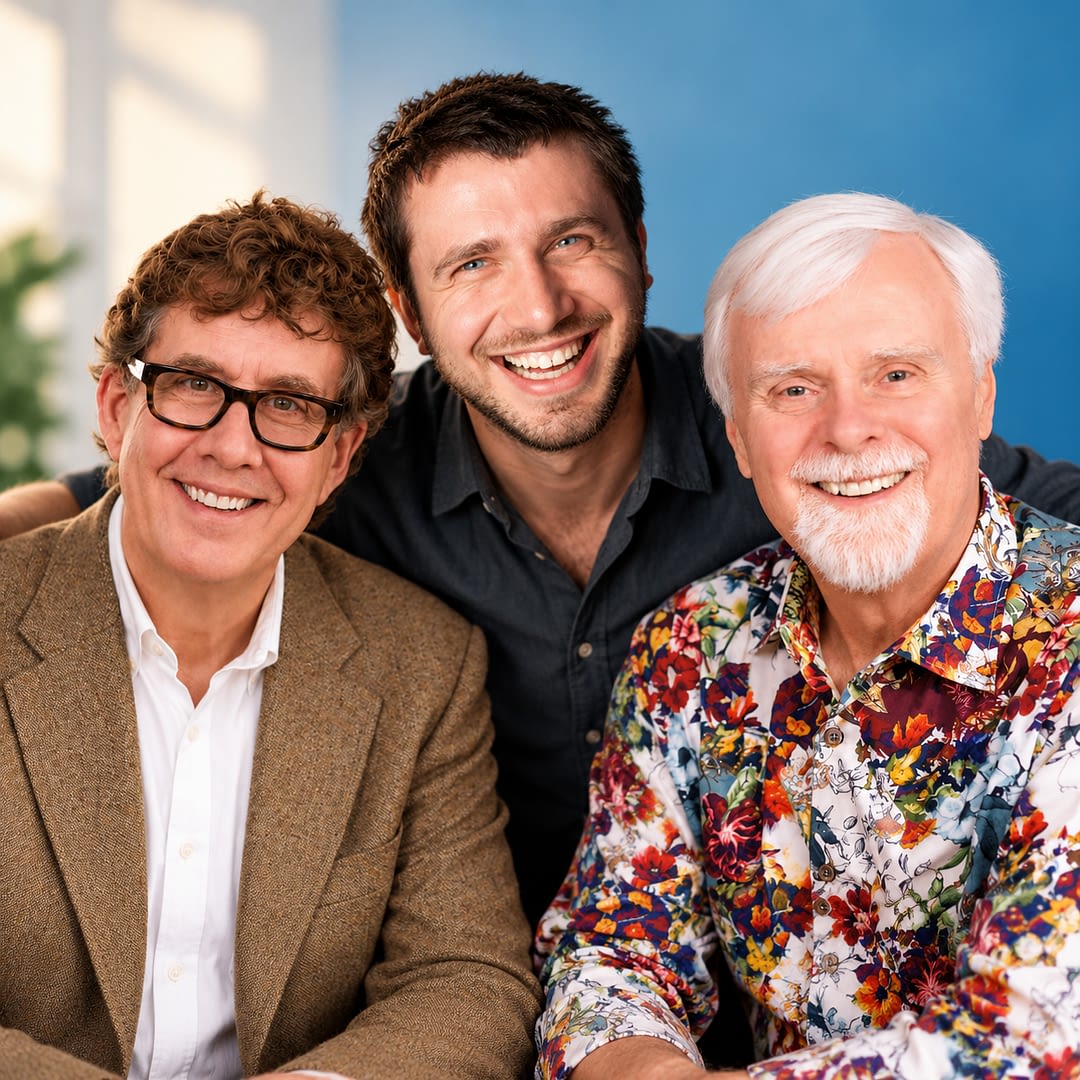
David’s Big Ideas (Pt. 1):
Can Recovery Really Happen in a Single Day?
Hosts:
Dr. David Burns
Kevin Cornelius, LMFT
Guest:
Jeremy Karmel
What if everything you thought you knew about psychotherapy was wrong? What if overcoming years—or even decades—of depression and anxiety didn’t necessarily require months or years of treatment? What if profound emotional change could happen in a single session, or even in a matter of seconds?
In this episode of The Feeling Good Podcast, Dr. David Burns joins Kevin Cornelius and Jeremy for the first installment of a fascinating new series exploring some of David’s biggest, boldest, and most controversial ideas about psychotherapy.
David challenges the conventional wisdom that emotional healing must be a slow, gradual process. Drawing on decades of clinical experience, he describes how TEAM-CBT can sometimes produce dramatic recovery from depression and anxiety in a single two-hour session—and why the most transformative moments often happen in a flash.
To illustrate, David revisits the remarkable story of Sarah, a therapist whose severe obsessive-compulsive disorder (OCD) had left her terrified of germs and trapped in exhausting cleaning rituals. In a dramatic live demonstration at Stanford, Sarah confronted her worst fears and experienced a stunning emotional breakthrough.
The conversation also explores David’s provocative idea that depression, anxiety, and anger can resemble hypnotic trances—states in which distorted thoughts feel unquestionably true. When those thoughts are exposed and challenged, the emotional spell can suddenly break.
Along the way, Kevin, Jeremy, and David discuss the importance of empathy, overcoming resistance, the power of exposure, and why effective therapy requires much more than simply talking about problems.
Key Takeaways
- Recovery doesn’t always have to take months or years. David describes his clinical experience helping people achieve dramatic reductions in depression and anxiety symptoms in a single extended session. He also explains why relationship difficulties, addictions, and other challenges may require a different approach or more time.
- Profound emotional change can happen in seconds. David suggests that recovery often occurs during a brief moment of insight, when someone suddenly recognizes that the negative thoughts driving their suffering aren’t true.
- Anxiety thrives on avoidance. Sarah’s remarkable experience with OCD illustrates how confronting feared situations through exposure can challenge catastrophic predictions and produce powerful emotional change.
- Empathy and trust create the foundation for change. Kevin emphasizes that Sarah’s breakthrough was possible not simply because of exposure, but because David had first established a trusting relationship, deeply understood her suffering, and helped her overcome her resistance to change.
- Depression, anxiety, and anger can feel like hypnotic trances. David proposes that these emotional states are often maintained by distorted beliefs that seem completely convincing—until a shift in perspective reveals a different reality.
- TEAM-CBT provides a systematic approach to rapid change. Testing, Empathy, Agenda Setting, and Methods work together to identify emotional problems, address resistance, and apply powerful techniques tailored to the individual.
- Recovery and relapse prevention go hand in hand. David explains why occasional returns of negative feelings are normal and how relapse prevention training can help people develop the skills to respond effectively rather than becoming trapped in prolonged suffering.
A New Vision for Psychotherapy
One of the most provocative questions raised in this episode is whether psychotherapy should be viewed as an ongoing relationship with an expert—or as a process that empowers people to become their own therapists.
David argues that the ultimate goal isn’t simply to help people feel better during their appointments. It’s to help them achieve meaningful emotional recovery and develop the tools to maintain those gains independently.
But can therapists really learn to produce such dramatic results? David acknowledges that TEAM-CBT can be surprisingly difficult to master, even for experienced clinicians.
And what about the durability of rapid recovery? If someone can feel better in a single day, will those improvements last?
Those questions—and several more of David’s big ideas—are coming up in the next installment of this series.
Listener Survey
We’d love to hear from you!
Your feedback helps shape future episodes and allows us to create content that is as helpful and meaningful as possible. Please use this link to take the feedback survey and share your thoughts with us about this episode.
Thank you for listening to The Feeling Good Podcast!
Contact Information
Kevin Cornelius, LMFT is a Level 5 Certified Master TEAM-CBT Therapist and Trainer and the Clinical Director of Feeling Good Institute–Silicon Valley. He specializes in the treatment of trauma, anxiety, depression, relationship problems and insomnia. You can reach Kevin at kevin@feelinggoodinstitute.com and visit his website at www.tools4change.me.
You can reach Dr. Burns at david@feelinggood.com.
Feeling down in these turbulent times? Take a ride on our Feeling Great app.
Feeling Great feels wonderful!
You owe it to yourself to feel GREAT!
Give the Greatest Gifts of ALL–Love and Happiness!