A New Model for Treating Trauma
Do You Need to Revisit the Past to Heal Trauma?
Episode Overview
In this episode, David and Kevin explore a provocative idea: healing from trauma may not require revisiting the past at all. Drawing from decades of clinical experience and data-driven research, David challenges a core assumption in trauma therapy and explains why focusing on the present moment can lead to rapid and lasting change.
Key Takeaways
- A Radical Shift in Trauma Treatment
- Traditional approaches often emphasize revisiting and “processing” past trauma.
- David argues that this may be unnecessary—and sometimes counterproductive.
- His clinical experience suggests trauma can often be resolved in a single session by focusing on current thoughts and feelings.
- The Power of the Present Moment
- Patients consistently want help with what’s bothering them right now, not necessarily past events.
- Changing how someone feels in the present can dissolve the emotional impact of past trauma.
- “The past is embedded in the present”—shift the present, and the past loses its grip.
- The Cognitive Model at Work
- Emotional suffering is driven not by events, but by thoughts about those events.
- When distorted thoughts are identified and challenged, emotional distress can rapidly disappear.
- This applies to trauma, depression, anxiety, and more.
- Data-Driven Insights
- Statistical modeling of patient data revealed that past emotional history does not predict recovery.
- In fact, including past data made predictive models less effective.
- Present-moment variables fully explained improvement.
Powerful Clinical Stories
Anne’s Story (Terminal Cancer Diagnosis)
- Faced with a devastating diagnosis, Anne experienced severe depression.
- In a single session, her distorted thoughts (self-blame, guilt) were challenged.
- Her depression dropped from severe to zero—and did not return over the next two years.
Trauma Workshop Demonstrations
- Across dozens of live demonstrations, participants with severe trauma experienced complete symptom relief within hours.
- Most work focused on present concerns—not revisiting traumatic memories.
Latvian Survivor’s Story
- A woman who survived Nazi-era trauma attempted suicide decades later.
- Her distress was tied not to past trauma, but to a belief: “I am worthless.”
- Challenging that thought led to rapid recovery.
Key Concepts
Healthy vs. Unhealthy Negative Emotions
- Healthy: sadness, grief, concern
- Unhealthy: shame, guilt, worthlessness
- Therapy aims to eliminate distorted, self-defeating emotions, not natural human feelings.
Exposure Therapy—Used Selectively
- Exposure can be powerful, especially for anxiety.
- However, it’s often not necessary for trauma recovery.
- David reports using it rarely in trauma cases.
No One-Size-Fits-All Approach
- Effective therapy requires a toolbox of techniques, not rigid adherence to one method.
- TEAM-CBT emphasizes flexibility and rapid testing of what works.
Practical Tools for Listeners
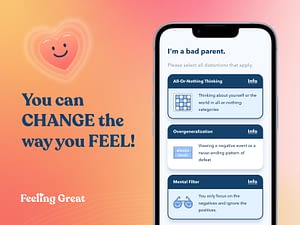
- Daily Mood Log: Identify and challenge negative thoughts in real time
- Cognitive Techniques: Learn to “crush” distorted thinking patterns
- Self-Help Resources:
- Feeling Good by Dr. David Burns
- When Panic Attacks Dr. David Burns
- Feeling Great Dr. David Burns
- Feeling Great App: Free tool to practice these methods interactively
Memorable Quote
“The moment you stop believing a distorted thought is the moment your negative feelings disappear.”
Final Thoughts
This episode offers a hopeful and empowering message:
You may not need to relive your past to heal from it.
By changing how you think and feel today, meaningful recovery can happen faster than you might expect.
What’s Coming Next
Next episode: A deeper dive into trauma treatment using memory rescripting, including when revisiting the past can be helpful.
Thanks for listening—see you next time!
Let Us Know What You Think of This Episode
Please use this link to take a very brief survey and share your opinion with us about this episode
Contact Information
Kevin Cornelius, LMFT is a Level 5 Certified Master TEAM-CBT Therapist and Trainer and the Clinical Director of Feeling Good Institute–Silicon Valley. He specializes in the treatment of trauma, anxiety, depression, relationship problems and insomnia. You can reach Kevin at kevin@feelinggoodinstitute.com and visit his website at www.tools4change.me.
You can reach Dr. Burns at david@feelinggood.com.
Feeling down in these turbulent times? Take a ride on our Feeling Great app.
Feeling Great feels wonderful!
You owe it to yourself to feel GREAT!
Give the Greatest Gifts of ALL–Love and Happiness!